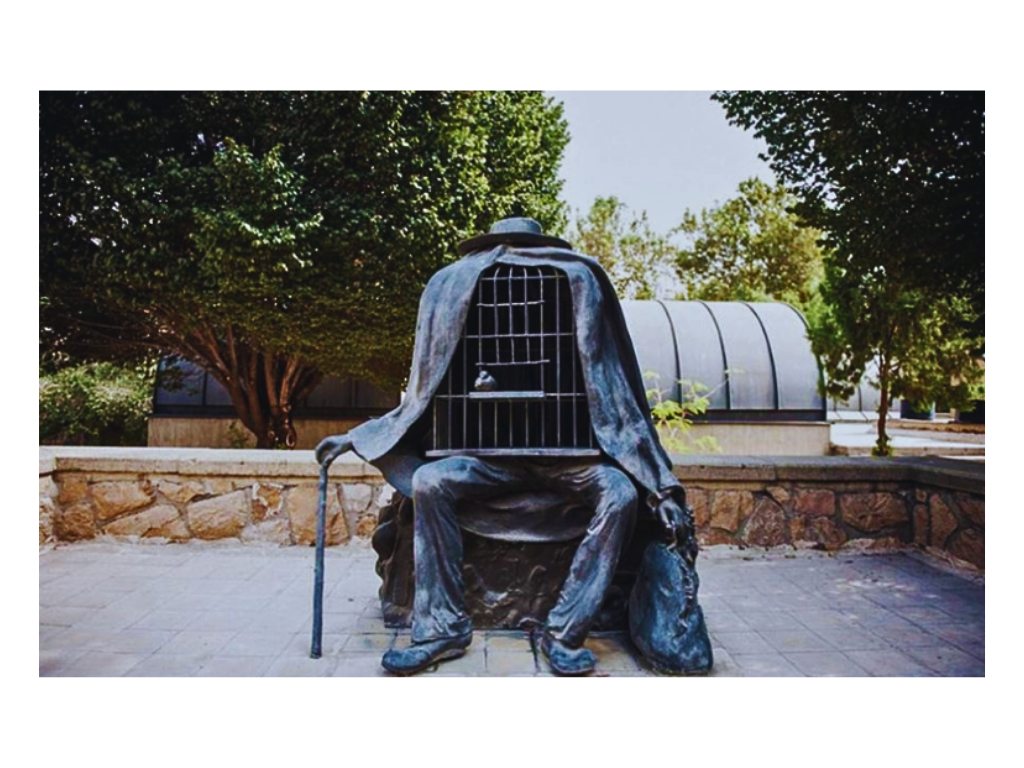
Photo Credit: “The Healer (Le Thérapeute)” (1967) sculpture by René Magritte at TMoCA
Why one of the world’s most valuable modern art collections has remained largely out of sight.
There’s a multi-billion-dollar modern art collection sitting in Tehran and most people outside the art world barely talk about it.
Inside the vaults of the Tehran Museum of Contemporary Art is a collection widely estimated to be between $3 billion to $5 billion, making it one of the most valuable concentrations of Western modern art outside Europe and North America.
The museum holds about 3,000 works in total, including 300–400 major modern masterpieces. Exact figures are not fully public, but art historians consistently rank it among the most significant collections beyond the Western museum system.
The full collection has never been displayed in its entirety since 1979.
How Iran Built its Blue-Chip Art Vault
In the 1970s, under Shah Mohammad Reza Pahlavi and Empress Farah Pahlavi, Iran invested heavily in soft power; positioning the country as a global cultural destination. Oil revenue was strong. The Western art market had not yet exploded to today’s stratospheric levels. Iran bought boldly. Acquisitions included works by Pablo Picasso, Jackson Pollock, Mark Rothko, Paul Gauguin, Salvador Dalí and many others.
Among the collection’s documented works is Andy Warhol’s commissioned portraits of Empress Farah Pahlavi and members of the Pahlavi royal family. Several of the estimated 14 pieces are believed to be under the museum’s ownership. Though their current condition has been debated. Historians note that some works from that era were defaced or damaged after the 1979 Revolution.

Photo Credit: Getty Images x GGD
Andy Warhol with Empress Farah Pahlavi in Tehran during the unveiling of his portrait series, 1977
After the 1979 Revolution
The country’s cultural priorities shifted. The monarchy fell, a theocracy took over. Many Western works, particularly those featuring nudity or imagery seen as politically or religiously insensitive, were removed from public display. Large portions of the collection were placed in storage. Some works were reportedly damaged or altered during the upheaval.
The collection however, was never sold off.
It was not shipped abroad. It was not quietly liquidated or auctioned. The Tehran Museum of Contemporary Art has retained ownership and continues to house the works.
Despite decades of political and economic instability, the collection has survived. Just like Iran. Even when fragile works required careful conservation, the museum did not relocate them permanently outside the country.
Hidden, but not gone. A massive archive assembled in the 1970s, still largely intact, though the precise condition of every piece is not fully public.
Throughout the years, parts of the collection have not remained permanently sealed away. A significant reopening of Western works took place in 1999. Selected pieces have been exhibited intermittently throughout the 2000s, 2010s and early 2020s. The museum’s “Eye to Eye” exhibition materials include images of works from its holdings, confirming that parts of the collection do come back into view. These include Rothko paintings valued between $100 million and $300 million, as well as Pollock’s Mural on Indian Red Ground, a 1950 masterpiece estimated by Christie’s to be worth at least $250 million. Empress Farah Pahlavi purchased it in 1977 for approximately $850,000.
Still, what the public has seen represents only a tiny portion of what exists.


Photo: Getty Images x GGD
The Tehran Museum of Contemporary Art, Designed by Persian architect Kamran Diba, first opened in the 1970s.
For a generation raised on global art fairs, Instagram museums, and billion-dollar auction headlines, the idea feels almost surreal: a blue-chip modern art archive, assembled before the market boom, sitting largely outside the Western spotlight.
What remains in Tehran is something rare. A goldmine that has moved between visibility and storage for more than four decades. A multi-billion-dollar archive of modernism by artists whose names now live on everything from Uniqlo t-shirts to Netflix films, still intact, still in Iran.
And hopefully, it remains.
VIEW MORE STORIES
